And the adventure began in Colosseo…The moment I saw the queues leading to the Colosseo entrance, I was quite let down. I felt as though I had so many places in my list with so little time. I found a spot with a good view of the Colosseo façade and sat down in the railing admiring the historical arena. Minutes later, I was approached by a young Italian lady offering a guided tour inside for 18 Euros. At first I hesitated for a lot of reasons, but when I heard that availing of the guided tour would mean avoiding the long queues, hesitations were put aside. I can always leave the tour group once inside.
The Colosseo ( or Colosseum) is also known as the Flavian Amphitheatre. Its common name was derived from a giant statue or colossus of Nero which stood close to the arena. Originally, up to 50,000 spectators (in which seating arrangements are based on social status) enjoyed the immense gladiatorial shows of violence and death.
 A closer look at the Colosseo with long queues of people waiting to get inside
 Julius Ceasar and his Roman guards?
 The amphitheatre has a hypogeum, a series of underground tunnel used to house wild animals and even slaves. It is said that a total of 500,000 people and more than a million wild animals died in the games.
Standing right next to the Colosseo is the Triumphal Arch or the Arch of Constantine dedicated to the victory of Constantine over his co-emperor, Maxentius. Constantine claimed he owed the said victory to a vision of Jesus Christ.
 a shot of the Arch of Constantine taken from the Colosseo
From Colosseo, I took the Metro to Spagna where I was greeted by hundreds of tourists in Piazza di Spagna from where you will find the Spanish Steps or the Scalinata della Trinità dei Monti named after the church that stands in the square above. The stairs is considered to be the longest and widest staircase in Europe. Since it was the peak of Spring when I was there, the Spanish steps was adorned with azalea blooms.
 The Lady and the Azaleas at the Spanish Steps
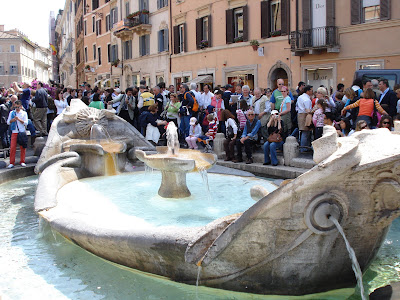 At the base of the Spanish steps is the famous Fontana della Barcaccia, The fountain is in the shape of a half-sunken ship with water overflowing its bows thus the name “Fountain of the Old Boat”.
One other reason that the Piazza di Spagna is always full of people is Via Condotti. It is the center of fashion shopping in Rome. Famous designers such as Valentino, Armani, Hermès, Cartier, Louis Vuitton, Fendi, Gucci, Prada, Chanel, D&G and Salvatore Ferragamo all have shops in that street.
 A mix of tourists and shoppers
Following the signs and equipped with my trusted map, I walked over the cobbled stones and from afar I had already heard its presence and as I got nearer, the sound of the gushing waters intensified. As I squeezed my way at the corner, the work of art that is Fontana di Trevi appeared in front of my eyes. It was just fantastic!!! I just had to get closer despite the crowd. I just had to throw a coin so I can return to the Eternal City. I just had to have my photo taken. ;-)

The backdrop of the fountain is Palazzo Poli, which becomes a part of the monument. The fountain features a central sculpture of Neptune, with Health and Abundance alongside and he is attended by tritons and marine horses.
 Neptune -at close
 The Magnificent Trevi Fountain - Photo taken from Wikipedia
With a cone of gelato that I bought from the gelateria that surrounded the fountain, I continued my way towards significant must-see spots that were situated within walking distance (or just for me) from each other.
The Pantheon, built between 27 AD and 25 AD, is the best preserved structure of its age and the architecture with the biggest brick dome. According to legend, it is the place where Romulus, the founder of Rome was seized by an eagle at his death and taken to the skies with the gods. It was later on converted into a Catholic Church in the 7th century.
 Piazza Navona is one of the few places where you can pick out some artwork whilst eating your dinner.
Before taking the Metro towards Piazza del Popolo, I managed to take a quick shot of Bernini’s Triton Fountain in Piazza Barberini.
 Triton Fountain
Piazza del Popolo features two symmetrical churches, an Egyptian obelisk and is dominated by the Porta del Popolo, which leads to the Via Flaminia. It also has two fountains on opposite sides.
 The Twin Churches and the Obelisk - Piazza del Popolo
 Steps lead from the Piazza del Popolo to the Pincio to the east
Tired but satisfied of my day tour, I headed back to the collegio but was not able to resist the urge to drop by the St. Peter's Basilica which,as stated in my previous entry, turned out to be a very good decision.
Travelling and exploring Rome alone was not bad at all...in fact it will be one of my memorable trips that I will never forget. Ever!


.JPG)